FUSE Found the Users We Were Losing on Mobile
A use case from our own workspace: FUSE read our Google data, found the mobile visitors the product was turning away, and changed the FUSE roadmap.
Half of the Google clicks that reached FUSE.is in 2026, organic search and paid combined, came from phones. FUSE surfaced that from our own connected accounts, along with the part that stung: mobile visitors engage almost as well as desktop visitors, then convert at a fraction of the rate, because the product told them to come back on a desktop. That finding is why the FUSE mobile beta now exists.
We were paying for mobile clicks and then telling the people who clicked to come back on a desktop. Nobody caught it in a meeting. We caught it by asking FUSE about our own traffic, in the same workspace our customers use, and the answer changed our roadmap. This is what the product found, with every number counted against a named source.
Three Sources, Three Different Answers
We asked in plain language and read three connected sources. Every share in the table covers 2026 so far, January 1 to August 27, and the size of the answer depends entirely on which door people came through:
| Source | What is counted | Mobile share, 2026 |
|---|---|---|
| GA4 | Sessions on FUSE.is | 15.5% |
| Google Search Console | Clicks from Google search | 24.3% |
| Google Ads | Paid clicks | 73.2% |
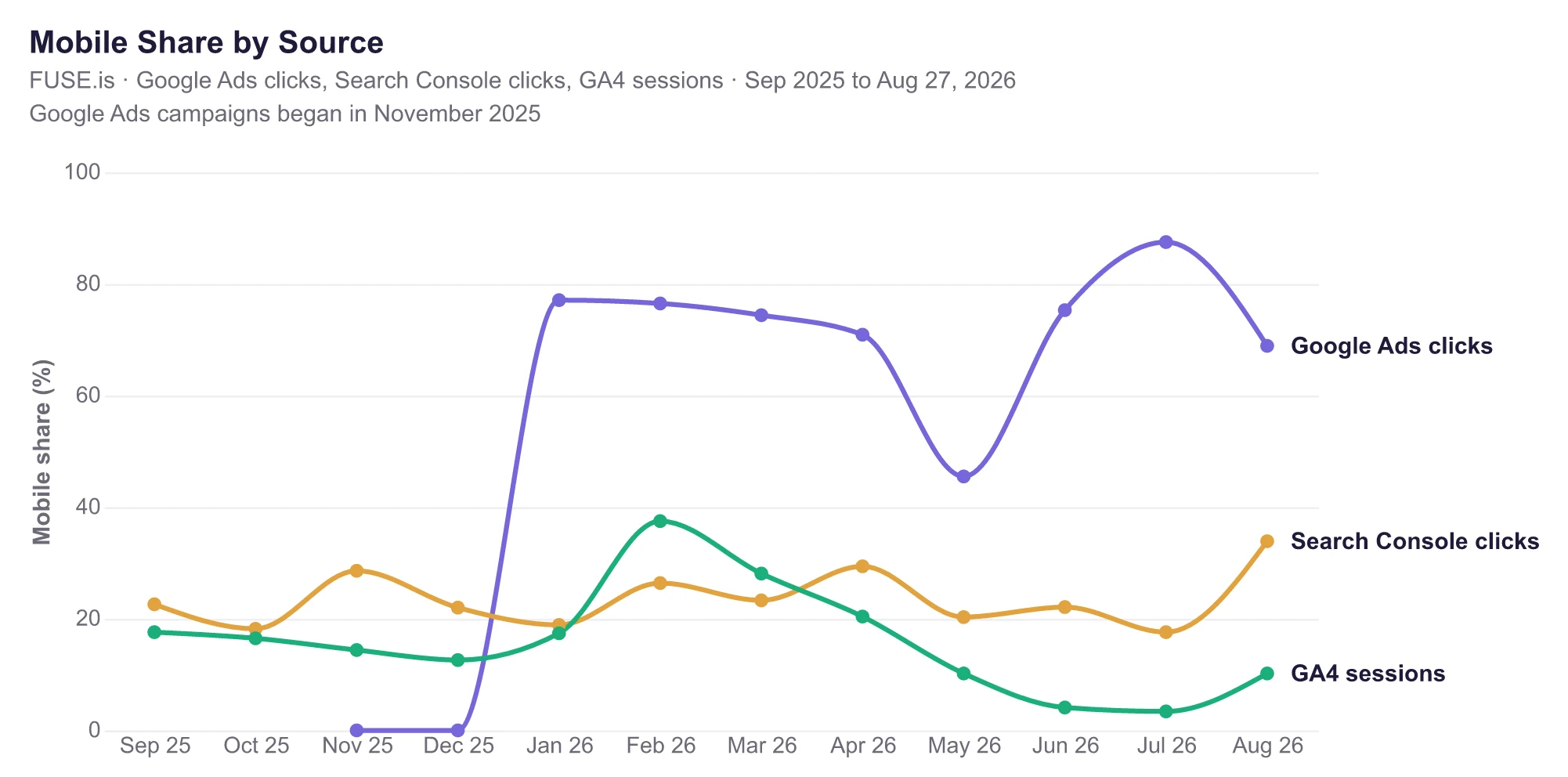
Three lines, three denominators, and only one of them holds steady. Organic clicks stayed between a fifth and a third every month, back through late 2025. GA4 sessions is the line that falls away: mobile sat in the mid-teens through late 2025, peaked near 38% in February, then thinned to single digits by summer. Paid is the line that flipped: when the campaigns started in late 2025 they served almost nothing to phones, and by 2026 they were sending most of their clicks there. That gap between who arrives and who stays is exactly why a top-line look at recent sessions hid the mobile audience.
Blend the two Google click sources, organic and paid together, and half of the clicks reaching FUSE.is this year came from phones. That is a share of Google clicks, not of all visitors, and naming that denominator is the difference between this number and the 15.5% session share above.
Two smaller findings came with it. Mobile searchers who see FUSE in Google results click at roughly twice the rate of desktop searchers over the last 90 days. And our paid campaigns sent nearly three quarters of this year's clicks, 73.2%, to the one kind of device the product did not support.
The Number That Stung
Engagement told us mobile visitors were not bouncing. In the 90 days to August 27, the GA4 engagement rate, the share of sessions that count as engaged, was 77.8% on mobile versus 79.3% on desktop. Then the funnel fell off a cliff: mobile accounted for 5.2% of those sessions but only 2.4% of key events, GA4's name for the actions we count as wins.
Visitors who engage normally and then stop converting are not a traffic quality problem. They are hitting a wall. Ours was literal: a screen asking them to come back on a desktop. FUSE flagged the pattern without being asked about mobile at all; the gap between healthy engagement and collapsed key events was sitting in the answer.
The Decision the Data Made
FUSE now runs on the phone. The mobile beta is live: open the same address in your phone browser and the workspace reshapes to the screen in your hand. It wears the beta label while it earns the bar the desktop product set.
The order of events is the point. The roadmap did not change because someone advocated for mobile in a planning meeting. It changed because the product read the accounts we already had connected and put the loss in plain sight.
We Did Not Build a Report to Find This
Everything above came from asking one plain-language question in a workspace with Google Ads, GA4, and Search Console connected. No report building, no export, no spreadsheet. This is the job our 2026 guide to AI marketing tools calls the decision layer: reading what is working across the accounts you already run. FUSE answers are built from live data pulled directly from your connected platforms through their official APIs, not from a model's memory. Every analytical response traces back to a recorded tool call.
The same question works on your accounts: what share of your traffic is mobile, by source, and what do those visitors do next? If the answer looks like ours did, you will know exactly what to fix. Teams that live in Claude can ask it through their connected accounts there.
Questions We Get
Can FUSE break down my traffic by device?
FUSE breaks down traffic by device for any workspace with Google accounts connected. Ask in plain language and it reads sessions by device from GA4, clicks and impressions by device from Search Console, and paid clicks by device from Google Ads, then compares what those visitors did next.
Does FUSE work on a phone today?
The FUSE mobile beta is live. Open FUSE in your phone browser at the same address you already use; there is no app to install. The analysis in this article is the reason the mobile experience exists. It carries the beta label while polish continues, and the full launch gets its own announcement.